
For your 5kw multi-fuel stove, you'll need a room with a volume between 70 to 100 cubic meters to guarantee ideal operation and safety. This size accommodates the stove's need for free air movement and effective heat distribution, while also adhering to safety guidelines, such as maintaining appropriate clearance from combustible materials. Proper insulation and ventilation are essential; they help maintain the efficiency of your stove by enhancing thermal performance and verifying there's enough combustion air. Considering these factors not only enhances your stove's efficiency but also improves your comfort. Exploring the specifics of these guidelines reveals further insights into tailoring your setup for maximum benefit.
Understanding 5kw Stove Requirements
Before choosing a 5kw multi-fuel stove, you need to understand its space and installation requirements. This type of stove can burn various fuel types, including wood, coal, and smokeless fuels, which affect both the stove's efficiency and the heat distribution within the room. You must guarantee there's adequate space not just for the stove itself but also for safe operation and effective heat dispersion.
The installation space should include a non-combustible hearth and maintain specific clearances from combustible materials, dictated by local building regulations. The area around the stove must allow for free air movement, facilitating ideal heat distribution throughout the room. This is essential as improper placement can lead to uneven heating and potentially hazardous conditions.
Furthermore, the stove's flue system must be correctly configured to guarantee safe and efficient operation. It should be properly insulated and maintain a steady draft to carry emissions out of your home effectively. This setup is crucial in preventing backdrafts and ensuring that the stove operates within safe parameters.
Calculating Room Volume
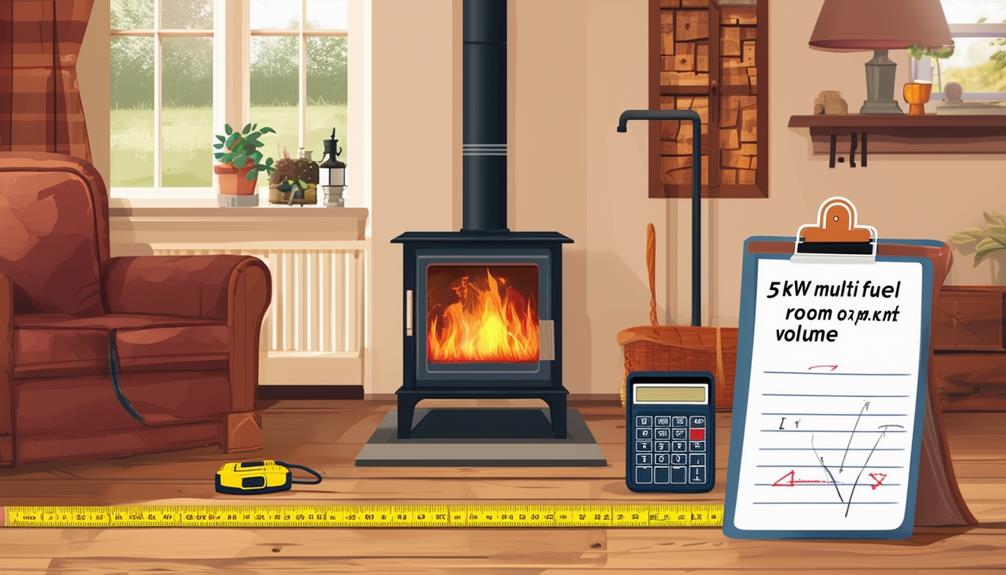
To determine if a room is suitable for a 5kw multi-fuel stove, you'll need to calculate the room's volume accurately.
Start by measuring the room dimensions: length, width, and height. Use a reliable tape measure and record your measurements in meters for precision.
Multiply the length by the width and then by the height to get the volume in cubic meters (m³). For example, if a room is 5 meters long, 4 meters wide, and 2.5 meters high, the calculation would be 5 x 4 x 2.5 = 50 m³. This volume is critical as it directly impacts the stove's efficiency and heat distribution throughout the space.
It's crucial to make certain that the stove's output matches the room size for ideal heat distribution. A 5kw stove typically requires a room volume between 70 to 100 m³, considering normal insulation and ceiling height.
If your room's volume is considerably lower, the stove may overheat the space. Conversely, if the room is too large, it won't be heated sufficiently.
Importance of Insulation
While calculating the room's volume is a key step, it's also important to contemplate how well the space is insulated. Effective insulation materials directly influence the thermal performance of your room, impacting how efficiently your 5kw multi-fuel stove heats the space.
You've got to understand that insulation acts as a barrier to heat loss, particularly during the cold months. The better insulated your room is, the more effectively it retains the heat produced by the stove, and less energy is required to maintain a comfortable temperature. This isn't just about comfort; it's about efficiency and reducing your heating costs.
When selecting insulation materials, you should consider their R-values — a measure of resistance to heat flow. Higher R-values mean better insulation properties and more noticeable heat retention capabilities. Materials like fiberglass, cellulose, and foam typically offer good R-values and can be used in walls, floors, and ceilings to enhance your room's thermal envelope.
Moreover, don't overlook the installation quality. Even the best insulation materials can underperform if not installed correctly. Confirm that there are no gaps or compression of the insulation materials, as these can greatly degrade thermal performance. Properly installed insulation makes your heating system more effective and your room cozier.
Ventilation Needs
You must also consider the ventilation requirements when installing a 5kw multi-fuel stove to guarantee efficient and safe operation. Proper ventilation guarantees that there's enough combustion air available for the fuel to burn effectively, preventing dangerous carbon monoxide buildup and enhancing the stove's efficiency.
Firstly, understand that airflow management is vital. Your stove needs a steady supply of fresh air to support combustion. This is typically achieved through either direct or indirect ventilation methods.
Direct ventilation involves an air duct leading outside, directly connected to your stove. This method guarantees that the air used for combustion doesn't deplete the oxygen inside your room.
Alternatively, an indirect ventilation method might involve adjustable air vents within the room. These should be strategically placed to maintain an ideal flow of fresh air from outside, balancing the air pressure and temperature inside the room.
It's essential to calculate the minimum air inlet size required for your stove, which is usually specified in the manufacturer's guidelines. This calculation considers the output of the stove and the room size.
Failing to adhere to these guidelines can lead to incomplete combustion of fuel, resulting in soot buildup and increased emissions. Always verify compliance with local building regulations concerning ventilation to uphold safety standards.
Placement and Safety Guidelines
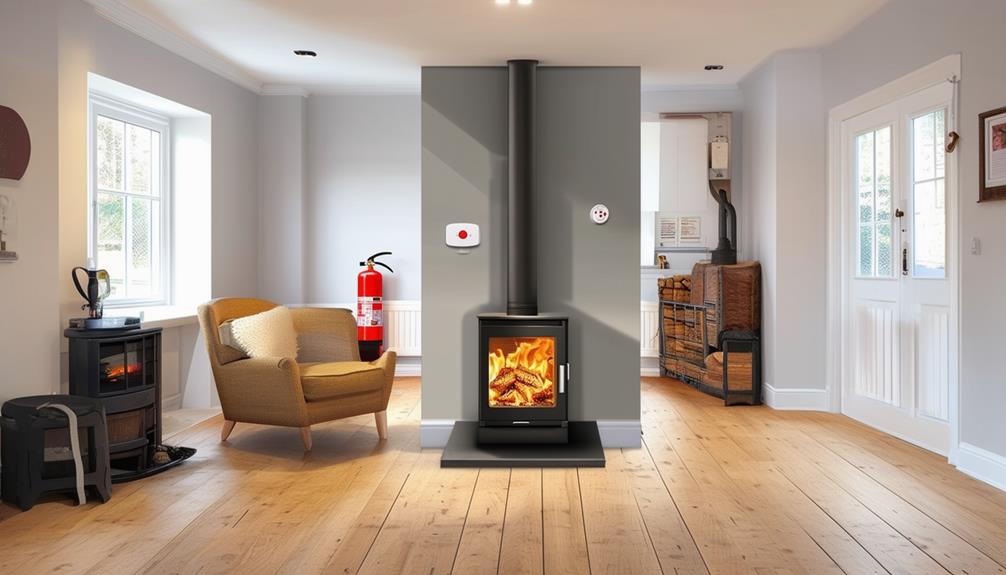
Guaranteeing proper placement of your 5kw multi-fuel stove is vital for safety and ideal performance. You'll need to adhere strictly to stove clearance regulations to prevent any hazards. These regulations dictate the minimum distance between your stove and any combustible materials, which varies depending on the stove's design and your room's layout. It's important to consult local codes and the stove's manual for specific requirements.
Fuel storage considerations are equally important. Storing fuel improperly can lead to safety risks including fire hazards. Make sure that your fuel is stored in a dry, ventilated area away from the stove to prevent accidental ignition.
Below is a table summarizing key placement and safety guidelines:
| Aspect | Guideline |
|---|---|
| Clearance | Follow local regulations and manufacturer specs |
| Surrounding Materials | Use non-combustible materials like brick or tile |
| Fuel Storage | Keep fuel in a dry, ventilated area |
Adhering to these guidelines not only guarantees your safety but also enhances the stove's performance by reducing risks of overheating and unexpected fires. Always prioritize these precautions when setting up your multi-fuel stove to enjoy a safe and efficient heating source in your home.
Maximizing Stove Efficiency
To enhance your stove's efficiency, verify it's properly maintained and the air intake settings are accurately adjusted.
Regular maintenance guarantees that the components are functioning at their ideal level, which greatly affects the stove's performance. You'll need to frequently check and clean the air filters and flues to prevent blockages that can impair air flow and heat distribution.
Choosing the right fuel types is vital for improving the efficiency of your 5kw multi-fuel stove. Hardwoods, for instance, are denser and provide a longer, more consistent burn compared to softwoods, which burn faster and produce more residue.
Each type of fuel impacts the heat output and efficiency differently, so it's important to select the appropriate material based on your heating needs and the specific capabilities of your stove.
To enhance heat distribution, consider installing a stove fan. These fans help circulate the warm air more evenly throughout the room, reducing hot spots near the stove and cold areas further away.
This not only improves comfort but also increases the overall efficiency of the heating system by harnessing the produced heat to its fullest potential.

Multi fuel stoves are an upcoming trend and the main reason as to why people are switching over to them Read more

As their name suggests, multi fuel stoves allow owners to burn a variety of fuels. They allow the use of Read more

A wood burning stove or multi-fuel stove can be part of a central heating system to keep your house warm Read more